Does your mix hold up in mono?
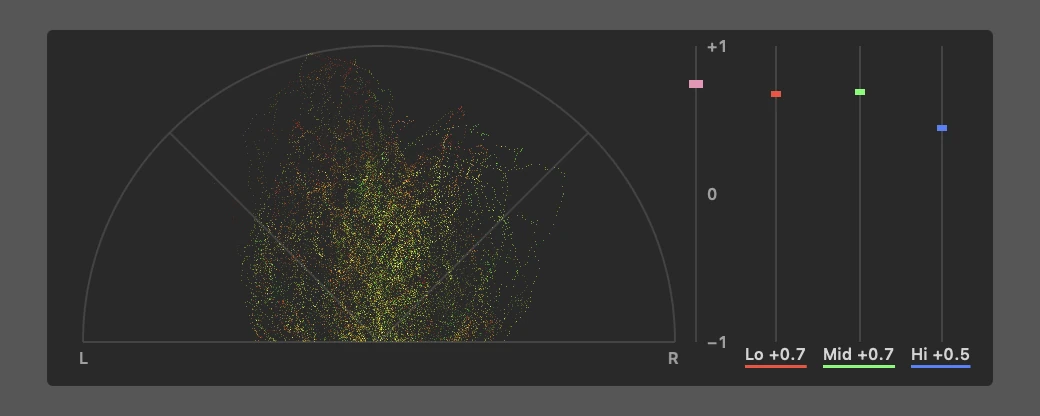
Your mix is rarely played in mono as a whole, but your bass almost always is. We measured the top 50 of the Billboard Hot 100 with MasterBar's stereo imager, band by band, to see what a mix that holds up in mono really looks like.
| Band | Correlation in hits | Lost in mono |
|---|---|---|
| Lows, below 200 Hz | +0.93 | 0.15 dB |
| Mids, 200 Hz to 2.5 kHz | +0.72 | 0.7 dB |
| Highs, above 2.5 kHz | +0.71 | 0.7 dB |
| Whole mix | +0.78 | 0.5 dB |
What the numbers mean
A correlation meter compares the left and the right channel. At +1 they are the same, so the sound is mono. At 0 they have nothing in common: wide, but not wrong. Below 0 they work against each other, and that part cancels out when the two are added up. Short dips below 0 on a reverb tail are normal. Long stretches below 0 on a bass, a kick or a vocal are not.
Where your mix is still summed to mono
Big venues, headphones, cars and phones held sideways all play in stereo. These still add left and right together:
- Subwoofers: in almost every club and venue the subs get one mono feed, also when the speakers above them play stereo. A wide bass loses its weight exactly where it matters most.
- A single speaker: most portable Bluetooth speakers and many smart speakers have one driver for both channels.
- Background music in shops, bars and gyms, which mostly runs in mono.
- Fills near the stage and delay towers at many live shows.
- FM radio in a car switches to mono when the signal gets weak.
- Mono settings on phones and in streaming apps, used by people who hear better with one ear.
So the lows need to work in mono everywhere. The mids and highs mostly need to survive a single speaker.
What 50 hits look like
- The bass is mono. 32 of the 50 hits read +0.90 or higher below 200 Hz. The exceptions are old stereo recordings, such as Dolly Parton's Jolene at +0.46.
- The highs are not wider than the mids. In 26 hits they are wider, in 24 narrower. A wide mix is wide in both.
- Below zero is rare. Per band, the correlation dips below 0 for 0.1 to 0.2% of a typical hit. Only 8 of the 50 spend more than 5% of the time below 0 in any band.
- Almost nothing is lost in mono. A whole hit gets 0.5 dB quieter when left and right are added up, the lows only 0.15 dB.
How we measured. The Billboard Hot 100 playlist on Spotify, numbers 1 to 50, on 8 October 2026, with the same filters MasterBar's stereo imager uses. No audio was stored, only the numbers. The Hot 100 is mostly pop, country and hip-hop; club music was not part of it.
Fixing it in Ableton Live
The usual causes of a mix that falls apart in mono: stereo samples in Simpler or Sampler, unison and spread on synths, chorus, ping-pong delay, stereo wideners, and a wide reverb on low sounds.
Most of it is fixed with Utility, the device that comes with Live:
- Bass Mono, a switch in Utility, puts everything below the frequency you set in the middle and leaves the rest as wide as it was. Engineers mostly set it between 100 and 150 Hz.
- Mono, also in Utility, puts the whole track in the middle. Use it on a stereo sample that has no reason to be wide.
- The phase switches for left and right, also in Utility, flip one channel when it works against the other.
Check it while you mix
Utility's Mono switch on your master tells you that something sounds thinner, not where. MasterBar's stereo imager shows the correlation for the lows, mids and highs at once, above Live, the whole time you work. Click a band to see it on its own.
What to look for, measured against the hits:
- Lows: close to +1. The hits average +0.93.
- Mids and highs: anywhere from +0.5 to +0.8 is normal.
- Any band below 0 for more than a moment: find the track that does it, and fix it with the switches above.
Questions
- Does mono compatibility still matter? For the bass, yes: subwoofers sum it to mono in almost every club and venue. For the rest, mainly on single speakers and background music.
- What correlation should my mix have? The hits read above +0.9 in the lows, around +0.7 in the mids and highs, and +0.78 as a whole. A reading near 0 is not wrong; long stretches below 0 are.
- Below what frequency should the bass be mono? There is no standard. Engineers mostly name 100 to 150 Hz, some go up to 200 Hz. In the hits, everything below 200 Hz averages +0.93.
- Why does my mix sound thin in mono? Something in it works against itself between left and right: often a widener, chorus, ping-pong delay or stereo sample. The band whose correlation drops tells you where to look.
- Should the highs be wider than the rest? They can be wide, but the hits do not make them wider than the mids.