How loud is your genre?
We measured 843 tracks in 17 genres with MasterBar's loudness meter, each played in full. The typical track runs from −5.3 LUFS in drum and bass to −19.7 LUFS in modern classical, and 13 of the 17 genres are louder than −9.
| Genres | Typical LUFS |
|---|---|
| Drum & bass, hardstyle, metal | −5.3 to −6.0 |
| Techno, hard techno, EDM | −6.5 to −6.7 |
| Rock, country, house | −7.5 to −8.2 |
| Hip-hop, indie, R&B, afrobeats | −8.5 to −8.9 |
| IDM, ambient, jazz | −13.4 to −14.9 |
| Modern classical | −19.7 |
How to read this
LUFS measures loudness the way the ear hears it. These are Integrated values: the average of a whole track. The mark in each bar is the typical track of that genre, the median. The bar shows where the middle 80% of its tracks sit.
The spread says as much as the number. Techno is tight: 80% of its tracks lie within about 2 LU, between −7.6 and −5.6. Modern classical spans almost 11 LU. Over all genres, 84% of the tracks are louder than the −14 LUFS Spotify plays at.
How we measured. About 50 tracks per genre, from popular curated genre playlists on a major streaming service, in October 2026. Each track played in full with the service's own volume levelling off. No audio was stored, only the numbers. We don't list the tracks or the playlists.
What this can't tell you. These are chosen playlists from one month, not whole genres. The IDM selection holds many older recordings and the jazz selection leans towards background listening. Pop has no row of its own: for chart music, see how loud chart tracks are.
Louder means less punch left
PSR is how far the peaks stand above the loudness: high means a track still breathes, low means it is squashed. It falls as genres get louder. Drum and bass, techno and metal keep 6.2 to 6.7 dB, R&B 9.1 dB, and jazz 13.6 dB.
Loud is not the same as flat
LRA, the loudness range, tells how far the quiet and loud parts lie apart, in LU. It does not simply follow loudness. Drum and bass is 3 LU louder than hip-hop, yet it moves more: 6.4 LU against 4.4 LU, with its breakdowns and drops. R&B and afrobeats are among the steadiest, at about 4.3 LU.
All the figures
| Genre | Typical LUFS | Middle 80% | True peak | LRA | PSR | Correlation |
|---|---|---|---|---|---|---|
| Drum & Bass | −5.3 | −7.5 to −3.5 | +2.4 | 6.4 | 6.7 | +0.84 |
| Hardstyle | −6.0 | −7.9 to −4.4 | +1.9 | 7.3 | 7.4 | +0.75 |
| Metal | −6.0 | −8.4 to −4.7 | +0.6 | 5.2 | 6.2 | +0.58 |
| Techno | −6.5 | −7.6 to −5.6 | +0.6 | 4.7 | 6.6 | +0.87 |
| Hard techno | −6.7 | −8.1 to −4.8 | +0.3 | 6.2 | 6.4 | +0.87 |
| EDM / big room | −6.7 | −7.6 to −5.6 | +1.2 | 5.7 | 7.1 | +0.83 |
| Rock | −7.5 | −9.3 to −5.4 | +0.3 | 5.0 | 7.7 | +0.73 |
| Country | −7.8 | −9.6 to −6.5 | +0.2 | 4.8 | 7.9 | +0.74 |
| House | −8.2 | −9.4 to −6.8 | +0.7 | 5.8 | 8.1 | +0.90 |
| Hip-hop | −8.5 | −9.8 to −6.6 | +0.6 | 4.4 | 8.4 | +0.94 |
| Indie | −8.7 | −11.6 to −7.1 | 0.0 | 6.1 | 8.7 | +0.73 |
| R&B | −8.8 | −10.7 to −7.3 | +0.2 | 4.4 | 9.1 | +0.86 |
| Afrobeats | −8.9 | −11.3 to −7.8 | +0.1 | 4.2 | 8.9 | +0.79 |
| IDM | −13.4 | −18.8 to −10.1 | +0.1 | 8.8 | 12.4 | +0.85 |
| Ambient | −13.8 | −16.8 to −11.2 | −0.3 | 8.7 | 10.7 | +0.57 |
| Jazz | −14.9 | −17.6 to −13.3 | −0.8 | 5.3 | 13.6 | +0.56 |
| Modern classical | −19.7 | −26.1 to −15.3 | −1.4 | 13.3 | 11.8 | +0.46 |
True peak in dBTP, LRA in LU, PSR in dB. Correlation shows how alike left and right are: at +1 the sound is mono, near 0 it is wide. Download all figures, with the frequency balance per genre, as a CSV file.
How the genres differ
This chart looks only at how the energy is divided, not at how loud a genre is. Low tones carry far more energy than high ones, even when they don't sound louder, so a small share of high end is normal.
- Hip-hop has about half of its energy below 60 Hz. Rock has 13% there.
- Techno and house both lean on the low end, but techno has more sub: 37% against 28%.
- Drum and bass spreads its energy most evenly over the low ranges: sub, bass and low mids each hold 28 to 29%.
- Jazz and modern classical have almost nothing below 60 Hz. Modern classical has 74% of its energy between 250 Hz and 2 kHz.
What the true peak figures mean
68% of the tracks go over 0 dBTP as the streaming service plays them, and 25% go over +1 dBTP. Part of that comes from the service's own encoding, so these figures are not a target. Streaming services ask for −1 dBTP at most.
How to use it
Use these as a check, not as a goal. A techno track at −12 LUFS will sound small next to its neighbours in a set; a jazz track at −8 is far louder than the music around it. Streaming services turn loud masters down either way, as the LUFS targets guide explains.
See it in Ableton Live
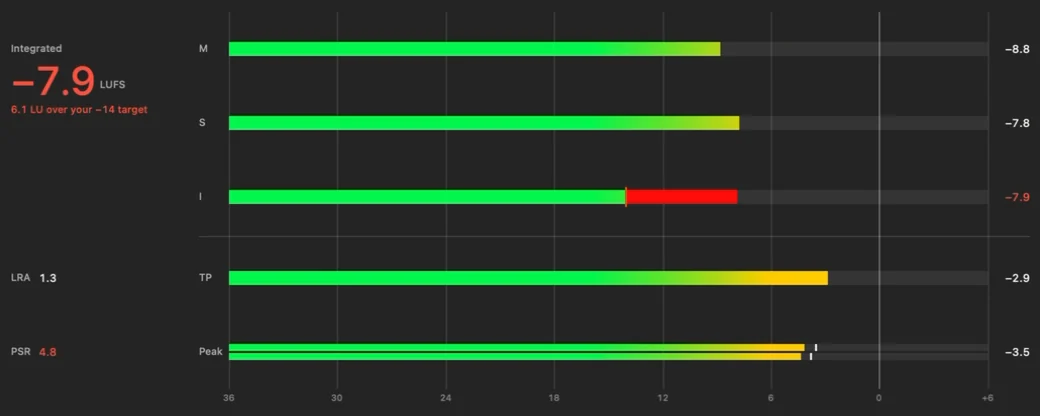
MasterBar sits above Live and shows Integrated, Short-term and True Peak the whole time you work, with LRA and PSR beside them. The loudness meter tells you how far you are from a target, and the spectrum analyzer compares your mix with a reference track.
Questions
- What is a good LUFS for techno? The typical techno track here measures −6.5 LUFS, and 80% lie between −7.6 and −5.6. Quieter is fine if it sounds right.
- What is a good LUFS for house? About −8.2 LUFS, with 80% between −9.4 and −6.8, so house is typically more than 1 LU quieter than techno.
- What is a good LUFS for drum and bass? The loudest genre here: typically −5.3 LUFS, with 80% between −7.5 and −3.5.
- What is a good LUFS for hip-hop? About −8.5 LUFS, with 80% between −9.8 and −6.6.
- Should I master to −14 LUFS? Only if you like how it sounds. −14 is the level Spotify plays at. Most genres here are mastered much louder.